
In this article
Ad creative is the most important lever for growth when it comes to performance marketing. Yet marketers are often expected to drive results without the design resources they need to produce a high volume of high-quality ad creative. So they turn to Canva or another tool to quickly create the ads they need, resulting in creative that isn’t optimized for growth or consistent with their brand’s aesthetic.
AI tools have made it easier to produce that volume—and we’ll cover some of the best ones below. But tools alone don’t create great ads that can convert. We’ll walk through why producing a lot of ad creative matters, 8 tips to set yourself up for success, and how AI can help you get there faster.
Looking to outsource your ad creative production to a strategic paid media partner? Scale your growth with Primer’s on-demand creative services.
Why you need a lot of ad creative
In a world where nine out of 10 ads fail, it's important to launch multiple ads at once. This approach allows you to quickly identify winners and scale them up so you can hit your goals. (For more on how we recommend launching and testing ads, read The Ultimate Guide to Outlier Method of Creative Testing.)
The key to this process, however, is consistency. Launching a lot of ads one time will help your ads just that one time. To maintain sustainable growth, you need a creative testing framework that ensures you are routinely planning, creating, launching, and optimizing ads.
In this post, we’ll talk about the best way to create the high volume of ads you need for this framework, but here are a few other resources to help plan, launch and optimize your ads as well.
8 tips for creating ad creative in bulk
1. Determine how much ad creative you need
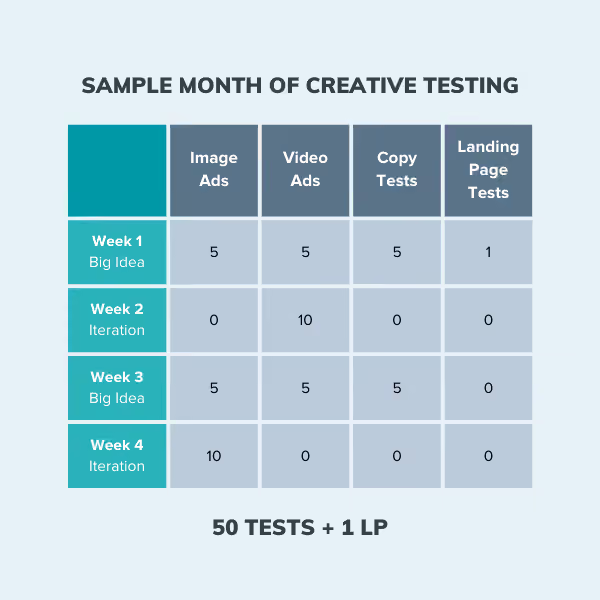
At Primer, we recommend a minimum of 50 ad tests per every $25,000 in ad spend to ensure you’re launching enough new ads to find a consistent stream of new winners. To find the exact number of ad tests (and failures) based on your CPA and ad spend, check out our Creative Testing ROI Calculator.
Those 50 tests could include copy and audience tests, but the majority should be visual tests, including image ads and video ads. Our team aims to test one new batch of image ads and video ads every two weeks, with a minimum of 5-10 tests within each batch.
Let's pretend you are spending $25,000 each month in digital advertising. Here's how we would plan your ad tests for one month.
2. Plan for two types of ad tests: big ideas and iterations
Per the Outlier Method, Primer alternates between “big idea” tests and iteration tests.
Big idea tests are exploratory in nature. They cast a wide net using an entirely new concept, such as a different value proposition or a new aesthetic, with no assumption that it will work. We’ll cover more suggestions below.
The purpose is to discover new winning ads that you wouldn't have found by staying in your existing creative lane.
Iteration tests, on the other hand, experiment with what's already working. They take a tried-and-tested winner and change one key element to squeeze more performance out of a direction you already know has potential.
As ad platforms have evolved, subtle tweaks are no longer enough for this type of test. For example, with Meta’s rollout of Andromeda for ad delivery, creative diversification has become the best lever for targeting.
The AI-powered system can identify creative that’s too similar and may suppress it. Simply swapping out a text overlay or adjusting colors will likely harm rather than help performance. Iterations should be based on shifts in narrative, positioning, or audience psychology.
Our experts have noticed these changes since the update:
- For image ads, avoid same-layout variations. The iteration needs to look and feel meaningfully different.
- For video ads, the iterations currently working best involve structural changes, such as shortening the length or switching from captions to voiceover. Just replacing elements like the hook won’t make an impact.
By creating multiple iterations of top-performing ads and testing those, you can thoughtfully scale your account’s wins and hone in on what really makes an ad work.
3. Create a testing roadmap
Now that you know how many tests you need for the month, you can begin to plan out your creative testing roadmap. At this stage, you are assigning concepts to each of these tests.
At Primer, we use Monday.com to plan and manage our testing roadmap, although any project management tool that allows you to track and collaborate on a project could work. Here’s a snapshot of our planning board we use with all of our partners to plan and manage our creative tests.
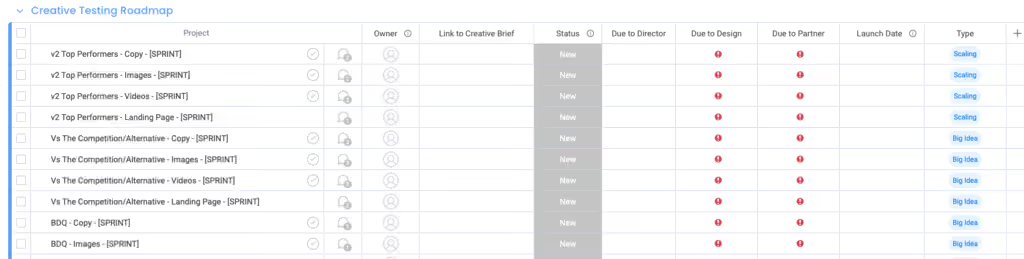
This central place for the testing roadmap helps us all stay on track and ensure that we’re working on our continuous creative pipeline to keep our partners’ ad accounts fresh and full of winning ads.
Plan out the next 2-3 months’ worth of tests at a time, assigning the concepts, deadlines, and owners to each test. Check out “What to test in your social media ads” for more ideas to fill out your testing roadmap.
4. Brainstorm big ideas
Ad fatigue is real. There comes a point when even your best-performing creative reaches its shelf life, so you’ll need to start from ground zero with all-new concepts. Creating iterations of something that has already plateaued likely won’t lead to winning ads.
When brainstorming big ideas, focus on concepts that do any one (or a combination) of the following:
- Emphasizes a totally different value proposition than your past tests
- Targets a different audience based on different buyer personas (e.g., change what gender or age range you're targeting)
- Uses a fresh visual look
- Includes all-new copy and headlines
- Is part of a larger, new campaign (e.g., ads that correspond with your brand's current influencer campaign)
5. Ground your creative in buyer personas
Strong ad creative speaks to your target audience’s questions, concerns, and motivations. Every concept in your testing roadmap should be tied to a clearly defined buyer persona.
As a starting point, ask yourself:
- Who is this person?
- What does their daily life look like?
- What problems are they trying to solve?
- What objections might stop them from buying?
As an example, think about a meal kit subscription service. Its ad for working parents might lead with the ease or time saved when preparing dinner, while one targeting health-conscious consumers might focus on the ingredient quality and nutritional benefits. Neither is better than the other; they’re merely speaking to different buyer personas.
Once you determine your ideal buyer, you can then figure out what types of questions they would ask before purchasing. These “buyer decision questions” should guide your copy, headlines, calls-to-action, and more. (Tip: Use our easy buyer decision question worksheet to figure these out for your brand.)
6. Dedicate consistent time to write your creative briefs
Now that you have your plan in place, it’s time to start writing your first creative briefs. Ad creative is the result of a creative process, hence the name. The best ad creative comes when you have time and headspace to dedicate to putting together a thoughtful and informed creative brief.
At Primer, we’ve developed a consistent weekly schedule for writing and submitting our creative briefs. We aim to write our briefs on Wednesdays and submit them on Fridays, giving us a day in between for review and revision. This kind of routine helps to ensure that we block out the time we need to write thoughtful briefs on an ongoing basis. Over time, it becomes a habit.
To help kick off your creative briefs, here are a few resources you might find helpful:
- Use the creative faucet method to get ideas flowing
- Steal from winning video ads with these 9 video ad templates
- Unblock writers’ block with these ad copy templates
- Get your videos started with 101 video hooks
7. Streamline the design and review process
Now comes the time to hand your ideas off to a designer for execution. How you manage this depends on your setup:
- In-house designer: Schedule a meeting to walk them through your creative testing roadmap, the importance of it, and how to get creative produced on a consistent basis. This helps them schedule it into their workflow and understand the priority from your perspective.
- Freelance designer: Use a project management tool like Monday.com, Asana, or JIRA to submit requests and track progress. With this many creative requests coming in, a central place for communication keeps both sides aligned and reduces confusion.
- On-demand design service: Services like Primer, No Limit Creatives, or Sketchdeck take time to understand your brand and provide specialized support based on the kind of creative you need. Project management is handled within their platform, and the accountability for delivering on your requests is on them, helping you to fill your creative pipeline more seamlessly.
Whichever option you choose, ensure you have a smooth process for both requesting and reviewing creative. Feedback shared over email or Slack can get lost easily, leading to unnecessary rounds of revisions.
At Primer, our Review Studio lets you view content in real time, approve or reject creative, and leave comments—all in one place. This replaces the back-and-forth of email chains, chat threads, or shared docs with a more streamlined, straightforward process.
8. Repeat
The most important part of this process is also the hardest: repeat this every month. To keep your creative pipeline full, it’s important to repeat this process and stick to a consistent schedule. As you build your process and the resources you need to get it done, the easier it will be to consistently produce the ad creative you need to find sustainable growth in paid advertising.
9 AI tools to help scale creative production
AI can definitely speed up your timeline, generating visual assets, videos, and copy in a matter of clicks—but keep in mind that your results will only be as good as your strategy.
Below are some useful tools for scaling creative production, organized by function:
Best for visual asset creation
- Claude Design: Anthropic's AI design tool
- Nano Banana: Google's image generation and editing platform, powered by Gemini
Best for video ad production
- Creatify: Creates UGC-style short-form video ads
- Runway: Professional-grade video generation and editing
Best for ad copywriting
- Copy.ai: Generates platform-specific ad copy at volume
- Anyword: Predictive copywriting tool with scoring for conversion performance
Best “all-rounders”
- AdCreative.ai: Produces conversion-focused visuals and copy, with a built-in scoring feature
- Pencil: Generates, predicts, and improves creative performance across formats
- Canva Grow: Canva's all-in-one ad platform
Scale your ad creative with the right partner
Though the tips and tools in this post can help with building a high-volume creative pipeline, producing winning ads requires more than just output or speed. An expert hand at the helm will know which concepts to prioritize, how to interpret performance data, when to iterate or start fresh with a big idea, how algorithms are shifting, and more.
Primer offers growth-focused creative services that cover everything you need to meet your business goals—from on-demand ad creative you can get in as little as two days to full-service creative strategy and management. Get in touch with us to find out how we can elevate your paid media strategy with better creative.
.avif)
.avif)
.avif)
.avif)
.avif)
.avif)
.avif)


%2C%20Color%3DNegative.svg)
.svg)