.avif)
In this article
It may seem early, but August is the best time to start planning your Black Friday and holiday season ads. Starting early will not only give you plenty of time to test, learn, and iterate, it will also allow you to take advantage of the learnings you’ve gained along the way.
By the time BFCM arrives, you don’t want to be figuring out which angles, messages, creators, and concepts work. You want to already know your winners and be ready to scale them.
And with higher costs, daily fluctuations, and a much bigger demand for content around the corner, the earlier you start, the more room your team has to make smarter decisions without the last-minute scramble.
Don’t let it sneak up on you! Here’s how to prepare in a way that minimizes cost and allows you to spread your bandwidth out over a few extra weeks of prep.
Your Week-by-Week Plan
Black Friday is still a few months away, but that doesn’t mean you should start building your BFCM ads today. It means you should start preparing for them.
Gone are the days when an overlay could do all the heavy lifting. With Meta’s Andromeda and increasingly sophisticated learning algorithms across platforms like TikTok, advertising has continued to move toward broader targeting—putting more of the targeting work in the hands of the creative itself.
Every ad still needs to speak to someone: a specific persona, problem, motivation, desire, or reason to buy. That’s why the weeks leading up to BFCM should be spent testing angles, messages, hooks, formats, and creators to understand what actually resonates with each persona. And you don’t figure all of that out overnight.
So when Black Friday arrives, you’re taking what you already know works and building your seasonal creative around it.
Here’s how we’d use the next 12 weeks.
.gif)
Start Here
Before you decide what to test, make sure you have a clear source of truth for what’s actually happening in your account (and this is valid across all platforms) .
Start in-house. At minimum, run an internal audit to understand what’s working, what isn’t, and whether your setup is giving you reliable data to make decisions.
Your pre-BFCM checklist starts here:
- Check your tracking: Make sure pixels, conversion events, and APIs are set up and firing correctly.
- Review your UTMs and parameters: Confirm they’re consistent and passing the information you actually need.
- Check your integrations: Your platforms, sales data, and reporting should line up and tell the same story.
- Identify your current winners: Look at which ads, angles, messages,, formats, and creators are actually driving results for each persona.
- Find the gaps: What haven’t you tested? Which angles, hooks, or formats are missing from your current creative mix? Are there untapped personas you should be using to inform creative?
And what if you find something broken? That's the whole point of doing this early. A misfiring pixel or a broken UTM caught in Week 0 is a quick fix. Caught during Black Friday, it's lost revenue you'll never get back. If something's off and you're not sure how to fix it, get help now, you've still got time.
For smaller accounts, an internal audit may be enough to get you on the right track. But if you’re managing larger volumes of spend, creative, or campaigns, we recommend going one step further with an external audit.
Your internal team knows the account better than anyone, but that familiarity can also create blind spots. A fresh set of eyes can challenge assumptions, spot opportunities you may have overlooked, and give you a second perspective on what your data is actually telling you.
Week 12-8
Weeks 12 through 8 before BFCM are your big ideas window - early enough that a test can fail and still teach you something. This is the time to go broad and test new angles, new personas, new concepts, and new creators to find out what actually resonates before you commit to it.
And a quick note here: don’t build a pile of random ideas. Build a testing roadmap. Every concept you test should trace back to something you’ve learned from your account and have a clear reason for being there.
Before you launch a test, write down your hypothesis. We like to keep it simple:
Because [data/learning], we believe [change] will improve [outcome] by [a specific % or $].
Then map what you’re testing, the variables, the results, what you learned, and what you’ll do next.
At Primer, we launch new tests every two weeks. This testing cadence gives you enough time to find wins and pause under performing ads before launching something new. We recommend alternating between new ideas and iterations, striking just the right balance to find and scale your wins.
Week 8-4
By now, your first rounds of testing should be giving you a clearer picture of what’s resonating. Now it’s time to go deeper.
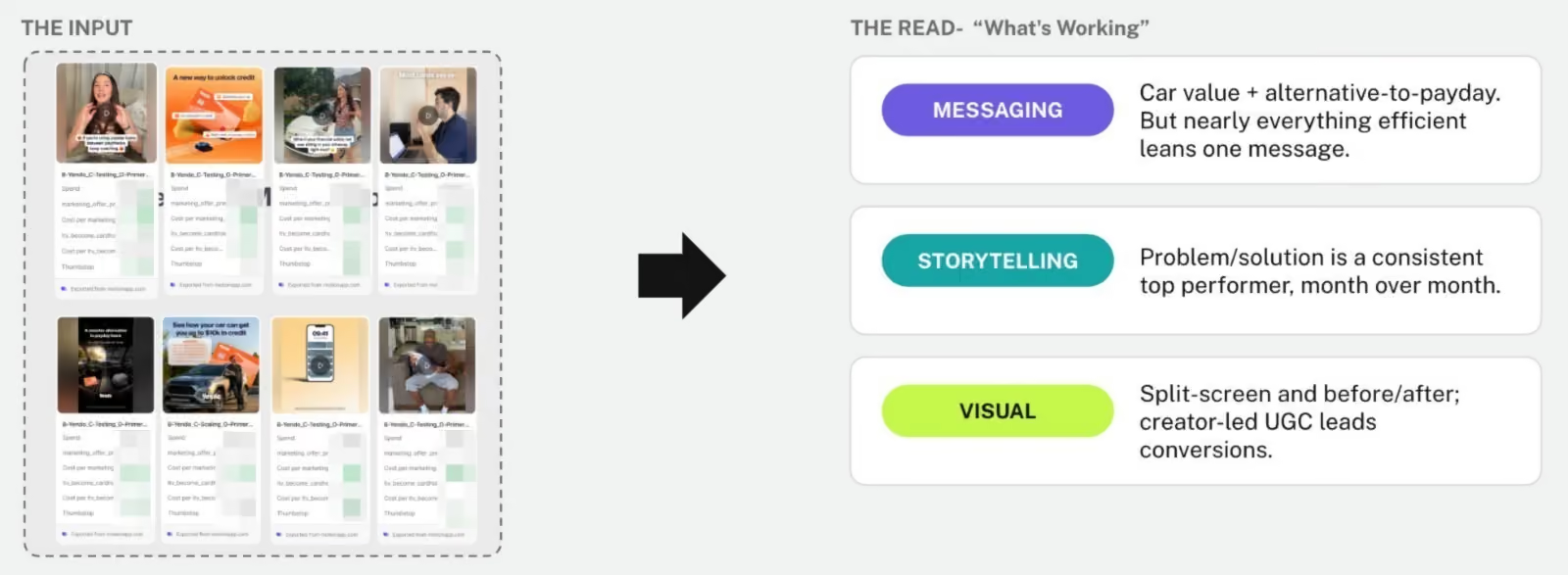
Start with your top performers, but don’t stop at “this ad worked.” Break down why it worked. Look at three things:
- Messaging: Which angles, benefits, pain points, or personas are resonating?
- Storytelling: Which structures are working? Problem/solution, before/after, testimonial, demo?
- Visual: Which executions are performing? Creator-led UGC, split screen, product-forward, static?
And remember, a good hook rate or low CPC alone doesn’t make an ad a winner. Look at the full picture and prioritize the creative that is actually driving the outcomes that matter to your business.
Once you understand what’s working, start iterating.
Week 4-2
By now, you should have more than a few winning ads. You should have a clearer picture of the messages, personas, storytelling styles, creators, and visual executions your audience responds to.
Now it’s time to use those learnings and apply them to your BFCM messaging, as this is when the proactive holiday shoppers will start making purchases
This is where you start taking your proven ingredients and turning them into Black Friday-specific concepts. And no, that doesn’t mean taking your evergreen winners and adding a sale banner or an overlay on top.
Take the messages and structures you’ve already validated and rethink them for the BFCM moment. That could mean testing:
- How your winning angle changes when there’s an offer attached
- New hooks built around urgency or timing
- BFCM-specific versions of your strongest UGC concepts
- Your best-performing creator delivering the offer in different ways
- Statics or videos that pair a proven message with a new BFCM execution
- Different ways of framing the same offer for different personas
The key is to build from what you’ve learned, not start over.
By the end of this phase, you should know which creative territories you’re taking into Black Friday and have enough variations ready to keep learning once BFCM begins.
Week 2
Black Friday is two weeks away.
Don’t wait until Black Friday itself to launch everything at once. We recommend starting early, as this gives your ads time to get out of the Learning Phase and into Active to really capitalize on Black Friday. Meta CPMs will be high for Black Friday and Cyber Monday, but if you start deals early, you can get good results before and after the actual Black Friday weekend.
And remember, your testing doesn’t stop just because you’ve entered BFCM mode.
You’ve spent the last 10 weeks learning which angles, personas, messages, creators, and executions work. Now you’re scaling those proven ingredients to maximize purchases as Black Friday appraches.In our testing, calling a sale “Black Friday” or “Cyber Monday” has increased conversion rates throughout November, even without a drastic discount. And here’s where all that prep starts to pay off: you already know the concepts underneath the promotion can perform.
On Black Friday
By the time Black Friday arrives, you’re not launching blind. You’ve tested your big ideas, identified your winners, iterated on them, turned those learnings into BFCM creative, and spent the last two weeks seeing how it performs in the market.
Now, follow the data.
Put more spend behind the creative and messaging driving results, pull back on what isn’t, and keep a close eye on performance throughout the day.
Some media buyers prefer to scale aggressively throughout Black Friday, increasing budgets as long as performance holds. Others take a more conservative approach, keeping budgets steady and waiting until Cyber Monday to decide what deserves more spend.
There’s no single right approach. It depends on your account, your margins, your budget, and how much risk you’re willing to take. What matters is that your decisions are based on what the data is telling you.
And keep your creative moving with the moment. Black Friday becomes Cyber Monday, and Cyber Monday becomes the holiday season. Take what worked, adapt the messaging, and keep iterating instead of starting from scratch.
That’s what the last 12 weeks were really about: not finding one perfect Black Friday ad, but building a system that helps you know what to do next.
Ready for Black Friday?
There’s a lot to do over the next 12 weeks, but there’s still time to do it right.
And if you’re not sure where to start, start with an audit. At Primer, we’ll take an outside look at your account, uncover what’s working, what might be holding you back, and where the biggest opportunities are before BFCM. Think of it as a second set of eyes to help you build your source of truth before the real testing begins.
Already know what you need but need more creative to get there? We’ve also built a new Primer On-Demand for brands that need extra creative firepower without adding another full-service agency to the mix.
And if you need the whole thing, from strategy and rapid testing to paid media and conversion-focused creative, that’s what Primer is here for.
However you’re heading into BFCM, the important thing is to start now. Let’s make the next 12 weeks count.
.avif)
.avif)
.avif)
.avif)
.avif)
.avif)
.avif)



%2C%20Color%3DNegative.svg)
.svg)