In this article
TikTok is no longer a newcomer in the digital advertising space. It's a global platform where brands spend billions on ads, and its Ads Manager has grown into one of the more sophisticated self-serve platforms available.
If you’re not already advertising on TikTok, we have many reasons why you should start. In this foundational guide, you'll find everything you need to know to get started with TikTok ads and launch your first campaign with confidence.
How do we know what works?
Primer has helped brands build and scale TikTok ad programs from the ground up. Along the way, we’ve learned what works and common pitfalls to avoid, particularly for beginners. Below is the framework we use to help brands succeed.
Are TikTok ads right for my company?
Before you dive in, keep in mind that TikTok isn't the right channel for every brand. Success depends on whether your target audience actually uses it.
If you're selling a high-ticket B2B SaaS product, TikTok is probably not where your buyers are spending time. But if you're a B2C brand targeting consumers in categories like beauty, wellness, apparel, food, or lifestyle, the platform’s reach and engagement are hard to ignore.
Step 1: Understand the campaign structure
Before you touch a budget or write a single hook, it helps to understand how TikTok Ads Manager organizes everything. Like Meta, TikTok uses a three-tier structure:
- Campaign: Where you set your objective—reach, traffic, app installs, video views, conversions, or lead generation. Your objective tells TikTok's algorithm what action to optimize for, so be intentional about which one you choose.
- Ad Group: Where you define your audience, placement, schedule, budget, and bid strategy. You can have multiple ad groups per campaign.
- Ad: The actual creative—video, copy, and CTA. Multiple ads can live within a single ad group.
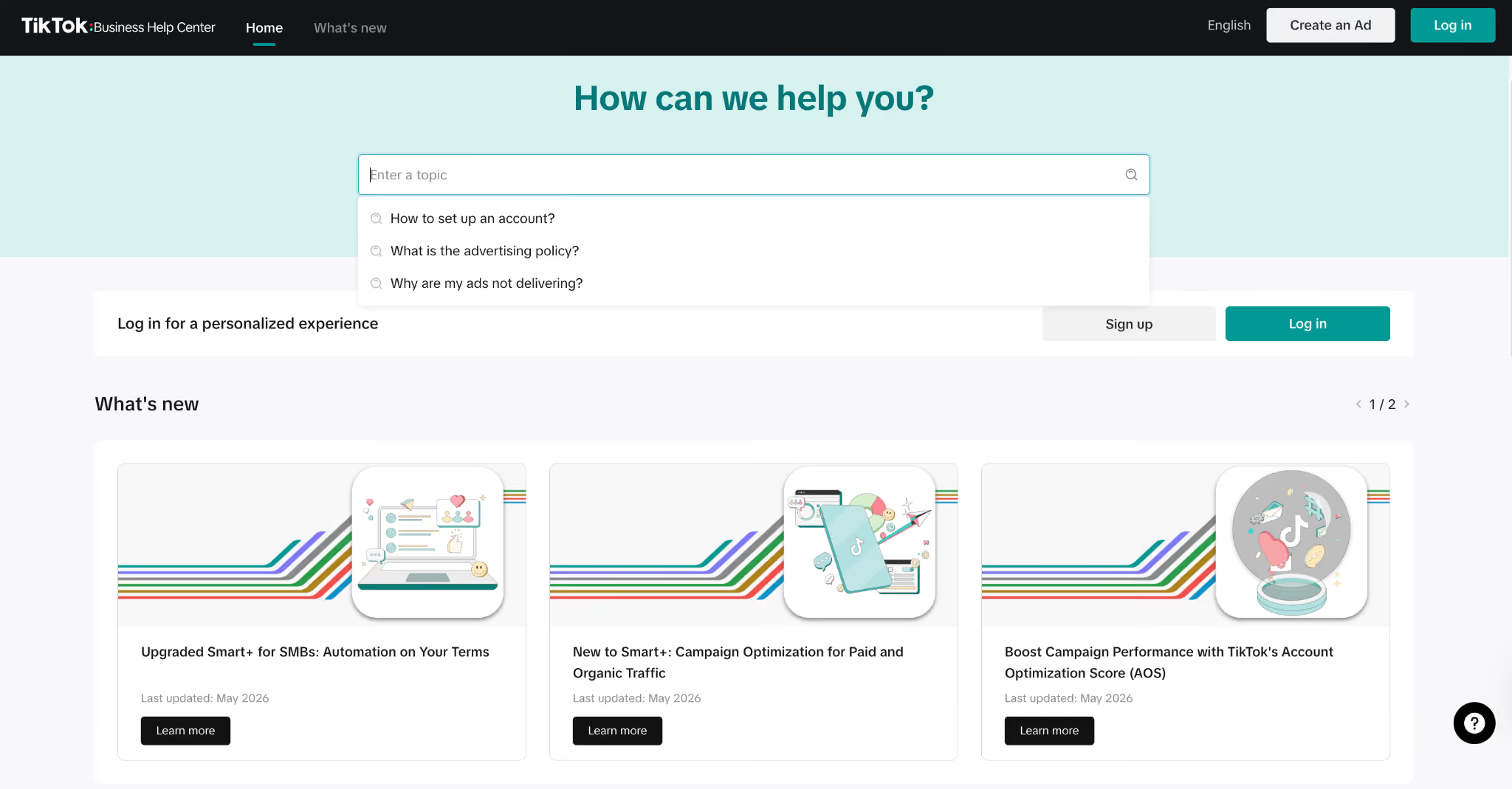
For beginners, TikTok's Business Help Center is the most reliable resource for understanding the platform's current structure and features.
Step 2: Determine your budget strategy
One of the first decisions you'll make is how to allocate budget: at the campaign level or the ad set level. This choice matters more on TikTok than on most other platforms because of how the algorithm's learning phase works.
The learning phase is the period right after you launch ads when TikTok's algorithm is gathering data to understand who responds to your creative. TikTok requires 50 conversions to exit the learning phase. If you are optimizing for a more expensive, bottom-of-funnel event (e.g., purchases), this can be hard to achieve without exorbitant budgets.
CBO vs. ABO
TikTok for Business has a lot of the same features as Meta’s Facebook Ads. Just like in Facebook Ads, you can choose to either do Campaign Budget Optimization (CBO) or Ad Set Budget Optimization (ABO). On TikTok, we recommend CBO if you're working with a smaller budget. CBO counts conversions at the campaign level, meaning you only need 50 total, not 50 per ad set. That makes it much faster to exit learning.
To make this concrete, imagine you're a DTC supplement brand spending $100 daily, optimizing for purchases at an average order value of $60. Under ABO with two ad groups at $50 each, you'd need each group to generate 50 purchases before the algorithm stabilizes.
This would amount to $3,000 per ad group just to exit learning, which most early-stage brands can't sustain. Under CBO, those 50 conversions are counted across the whole campaign, so the same $100 gets you out of the learning phase more quickly.
If you have a larger budget and want more control over where spend is allocated, ABO gives you that flexibility. The tradeoff is that TikTok's algorithm tends to concentrate spend on a single top performer under CBO. This is by design, but that top-performer could end up becoming a vampire.
If you are testing at scale, this could potentially hurt you because you may not be able to get enough spend on new creatives, or audiences, for them to perform. You could end up writing off a test as a failure, but in reality, it never had a fair chance. If you're running a high-volume creative testing program, ABO often makes more sense.
It’s important to know that unlike Meta, you cannot switch between CBO and ABO mid-campaign on TikTok. If you want to change your budget strategy, you'll need to launch a new campaign.
Step 3: Build your audience
TikTok offers several audience types. Oftentimes, the right approach for beginners is to start broad and narrow over time as you collect data.
Core audience targeting options
- Demographic: Age, location, gender, and language. Note that TikTok has advertising restrictions for minors, and the youngest selectable range is 13-17.
- Interest: Targets users based on long-term behavior patterns through broad categories (e.g., Beauty) or more specific keyword targeting (e.g., Skincare Routines). Keyword targeting typically produces modest differences from broad interest targeting.
- Behavioral: Video Interactions: One of the most powerful options. Targets users based on how they've interacted with specific types of content—for example, people who shared a video from the Beauty & Fashion category in the last 15 days.
- Behavioral: Creator Interactions: Targets users based on their engagement with specific creator categories.
- Lookalike: Works similarly to Meta's lookalike audiences. You'll need at least 1,000 signals on an event before creating a custom audience to build from. You can learn about TikTok's audience interaction logic here.
- Device: Target by operating system, connection type, or device price range—a useful proxy for income targeting.
For example, if you were launching a new line of sleep supplements, you might start by targeting users interested in Wellness broadly, then layer in behavioral targeting to narrow to people who have watched or shared sleep-related content during the last 15 days. This combination would give you a pool that's both directionally right and actively engaged with the topic—a much stronger signal than demographics alone.
Tip: If you find that certain interests or behaviors are working, try layering them for a larger (but still relevant) audience pool.
Step 4: Create ads that feel native to TikTok
Creative is where most brands stumble when they first come to TikTok. The platform's algorithm rewards content that feels like it belongs on the platform, not content that looks like a polished TV commercial or a repurposed Instagram ad.
When jewelry subscription brand Rocksbox launched on TikTok, its existing UGC ads—which had performed well on Meta—didn't convert. It wasn't until Primer rebuilt the creative around TikTok-native formats (fast-paced cuts, trending audio, voiceovers, quiz-style hooks) that performance took off, resulting in a massive 1,000% increase in purchases.

While nothing about Rocksbox’s product had changed, the creative approach made all the difference.
What makes a good TikTok ad?
TikTok's own Creative Best Practices research points to a few principles:
- Hook viewers in the first 3 seconds
- Use sound-on storytelling
- Include a clear CTA
The Creative Center is also worth bookmarking. It gives you access to top-performing ads by industry, keyword insights, trending audio, and even an AI script generator.
Use Spark Ads
If you're running ads from organic posts (your own or a creator's), use Spark Ads. Unlike standard ads, Spark Ads attribute all engagement—likes, comments, shares, follows—back to the original organic post. This means your social proof accumulates over time rather than resetting with every new ad. It also tends to improve performance because the ad feels more authentic.
According to TikTok's own benchmark data, Spark Ads drive a 134% higher completion rate and 157% higher view-through rate than standard In-Feed Ads, highlighting that native-feeling content is better at holding users’ attention.

How many creatives should you start with?
Don't launch a swarm of videos at once. TikTok's algorithm needs time to learn who responds to your content, so flooding it with too many assets at the start makes it harder to understand what's actually working.
A more effective approach is to start with 2-3 organic posts, identify which get the strongest early engagement and completion rates, and use those as your first ad tests. From there, introduce 2-3 new creatives per week and pause what's dropping off.
Step 5: Make adjustments—and don't be afraid to reset
TikTok's approach to campaign management differs from Meta in a key way: On TikTok, it’s actually okay (and many times beneficial) to relaunch a campaign or kick ads back into learning.
If performance starts tanking or your ads never gain momentum, launching a new ad or ad set can give the algorithm a nudge to take a fresh look at your creative.
However, exercise caution if your account is already performing well. If TikTok's algorithm is already keeping your CPAs low, there's no reason to disrupt it.
Tip: You can also use TikTok’s extensive audience learnings to inform your audiences for Meta ads. If an audience is high-converting on TikTok, there’s a high chance it will work on Facebook and Instagram too.
Step 6: Watch for creative fatigue
Creative fatigue is one of the most common reasons ad campaigns plateau. When users see the same ad repeatedly, they tune out. In fact, 88% of consumers say repetitive ads make them pay less attention.
On TikTok, this phenomenon tends to happen faster than on other platforms since people consume content at a high frequency.
When using the app organically, TikTok users never see the same video twice. To stay native to the platform, avoid over-exposing users to the same ad. Instead of running one video to exhaustion, rotate multiple creative variations using different hooks, music, and formats, so the feed experience stays fresh.
Two metrics to watch:
- CTR drops: Take a declining click-through rate as the first signal of creative fatigue. View-based conversions may still come through, but CPA will start to increase in the following days. That's your cue to refresh creative.
- CPA increases overnight: If CPA is high for two consecutive days, it's time to launch new content.
Step 7: Scale what's working
Once you have winning creatives and a campaign that's exited the learning phase, here's how to scale without disrupting performance:
- Test winning creatives against new audiences. Think creatively about who your buyer is and what they see on TikTok. Behavioral and interest targeting can surface segments you wouldn't have considered otherwise.
- Increase budgets gradually when you find a winner. When CTR starts to drop, pull back spend on that creative and shift budget to new tests.
- Try your TikTok creative on other channels. We've found that TikTok-native ads also perform well on Meta, Pinterest, and Snapchat. If a format is working on TikTok, it's worth testing elsewhere.
Ready to create your TikTok Ads?
Getting started on TikTok is more straightforward than it looks, but getting it right takes creative discipline, smart testing, and a willingness to keep iterating. If you’d like a team of experts to help build and scale a TikTok ad strategy, book a discovery call with Primer to get started.
.avif)
.avif)
.avif)
.avif)
.avif)
.avif)
.avif)


%2C%20Color%3DNegative.svg)
.svg)